

I’m publishing this alongside the previous post because understanding why things change is only half the equation.
The other half is what my girlfriends, sisters, and women in my life have been asking me for years:
What should I actually do?
What doctors should I see?
What treatments matter?
What’s noise — and what’s essential?
These questions didn’t start when I began writing here. They started long before that. When I learn something, I go find the best doctor I can, ask better questions, and share what I learn. I’ve been on this path since 2014 through functional medicine — and in the last year, very specifically, through the lens of perimenopause.
This post is for that broader circle.
Treat sexual symptoms as medical — not “lifestyle”
This came up again and again across clinicians.
If you’re experiencing:
vaginal pain or dryness
recurrent UTI-like symptoms
urinary urgency or leaking
loss of desire
discomfort with penetration
These are medical issues, not things to power through, normalize, or blame on stress.
One of the most important mindset shifts for me was this:
If it affects your body, sleep, confidence, movement, or relationships — it deserves care.
You are allowed to say:
“This is affecting my quality of life, and I want it treated.”
And if you’re brushed off, that’s not information.
It’s a signal to keep going.
Stop aging silently. Speak up. Ask directly. Demand sexual health support at every visit.
Vaginal estrogen: don’t wait (and don’t confuse it with systemic HRT)
This is where I wish I had known more earlier.
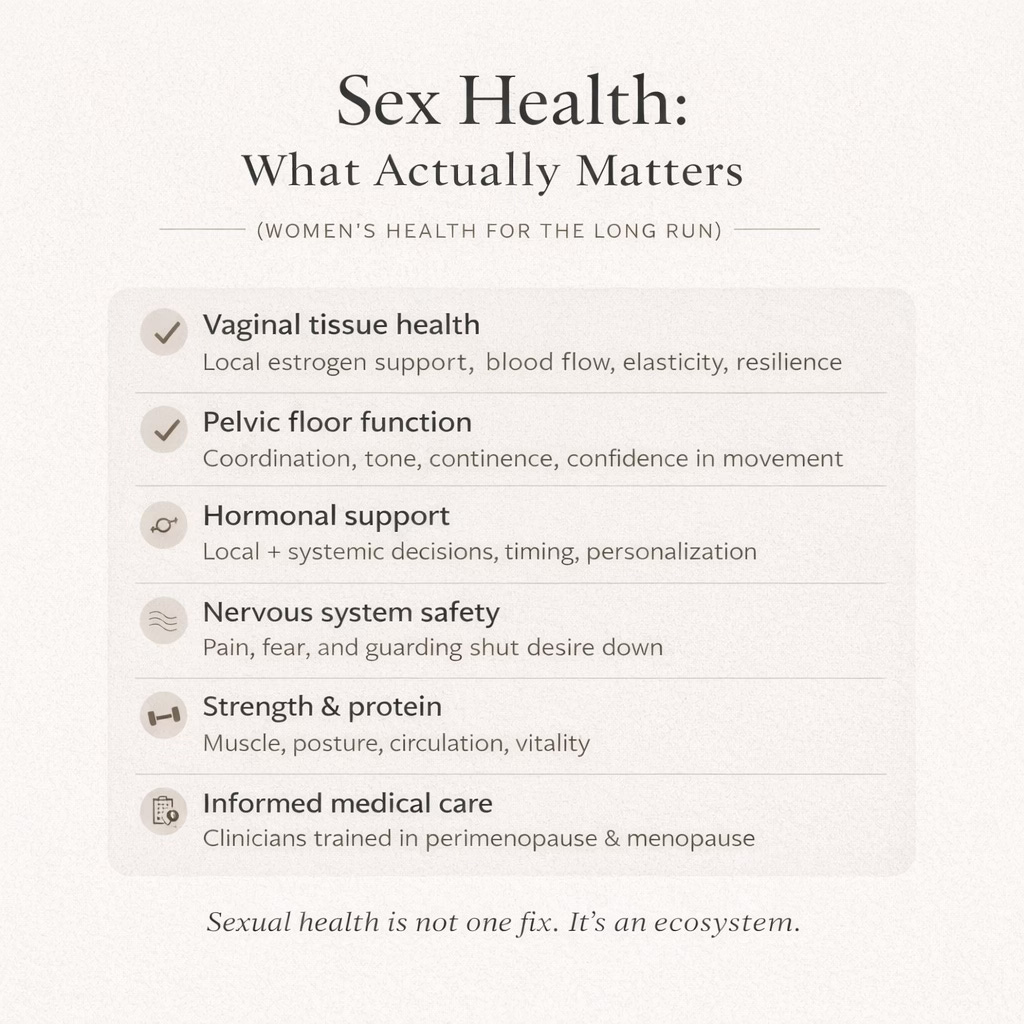
Vaginal estrogen is local, not systemic. It supports tissue thickness, elasticity, lubrication, blood flow, and resilience. It is one of the most underused tools in women’s health.
I didn’t have the luxury of starting sooner, not because I didn’t want to, but because I didn’t know, and because I was still navigating fertility decisions. We started with what was appropriate at the time.
I’m currently using a vaginal estrogen pill and a compounded estrogen + testosterone vaginal gel.
Now that I’ve decided not to pursue fresh IVF cycles for now — a decision I’m still emotionally unsettled about, but one my body and life needed — I can finally explore vaginal estrogen cream, which Dr. Casperson strongly advocates for restoring tissue health.
One thing she said that stayed with me:
We spend a fortune caring for the skin on our face, yet we’re told to ignore the tissues of our vagina — even though they’re just as hormone-responsive and deserving of care.
Vaginal care isn’t cosmetic.
It’s basic tissue maintenance.
Pelvic floor physical therapy (non-negotiable)
I’ve scheduled an evaluation with a pelvic floor physical therapist and now consider this a baseline appointment, not a “problem-solving” one.
What matters here isn’t theory. It’s action.
Why this belongs on your to-do list:
Pelvic floor issues often coexist with dryness, urgency, leaking, pain with sex, and loss of confidence in movement
Many symptoms don’t resolve with hormones alone
Pelvic floor coordination, tone, and function cannot be assessed without an internal exam
Early intervention prevents downstream issues that are much harder to unwind later
What to look for when booking:
A pelvic floor physical therapist (not a general PT)
Internal evaluation as part of the assessment
Experience with perimenopause / menopause patients
A clinic that treats urgency, leakage, pain, and sexual function — not just postpartum recovery
If you have a vagina and you’re navigating midlife changes, this appointment belongs in the same category as a mammogram or bone density scan: uncomfortable to schedule, invaluable to have done.
A few practical supports I’m also integrating:
Nervous system regulation matters: Use an acupressure mat for 15-20 minutes to calm the nervous system and reduce pelvic floor tension over time.
Blood flow matters: Sit on a semi-inflated squishy ball to increase blood flow and release deep pelvic tension.
Gut health matters: Prioritize fiber and hydration to prevent constipation; chronic straining accelerates pelvic floor aging and prolapse risk.
Systemic HRT — nuanced, personal, and worth real care
This part deserves honesty.
I recently decided not to pursue fresh IVF cycles, at least for now. Not because the question is settled but because my body and my life need care now. I still feel unsettled about this decision. I don’t know where I’ll land long-term.
What I do know is this: living in pain, depletion, and hormonal free-fall was costing me myself.
I have an upcoming appointment with Dr. Katherine Klos, a perimenopause- and menopause-trained clinician and urologist who practices between the Washington, D.C. area and Los Angeles, to explore systemic HRT thoughtfully and responsibly.
I tried progesterone briefly and had significant side effects. This isn’t unusual. As Dr. Mary Claire Haver has explained, a meaningful percentage of women don’t tolerate standard oral progesterone and need alternative formulations, dosing, or delivery methods.
This isn’t cookie-cutter medicine.
And that’s the point.
For women not navigating fertility decisions: yes, I would encourage learning about HRT earlier rather than later.
Much of the fear around hormone therapy stems from outdated interpretations of early studies. Over time, regulatory language has evolved, and advocacy by physicians like Dr. Casperson and others has helped clarify that hormone therapy must be evaluated by type, dose, route, and timing — not treated as a single risk category.
HRT isn’t mandatory.
It isn’t right for everyone.
But it does deserve informed discussion and freedom from fear-based medicine.
Train for Longevity: Strength, protein, and hormones work together.
Sexual health does not exist in isolation.
Muscle loss, bone health, estrogen protection, protein intake, and strength training all intersect with:
confidence
blood flow
metabolic health
long-term vitality
We’ll go deeper into this in future posts, but the takeaway here is simple:
Your sex health does not improve in a fragile body.
From a sexual-health lens specifically:
Strength training supports blood flow, posture, tissue health, and confidence
Protein intake supports muscle, hormones, and recovery
Vitamin D3 + K2 support bone health and hormone-responsive tissues
Hydration matters more than we think (I use electrolytes)
Creatine can be helpful for muscle, energy, and cellular health — more on that in the metabolic health post
What kind of doctors to look for
Most physicians are not trained in perimenopause, menopause, or hormone therapy, not because they’re careless, but because this education has historically been missing from medical training.
Many clinicians who are trained operate in hybrid or concierge models, not to exclude, but because the system doesn’t support longer visits or nuanced care.
This is not a personal failure.
It’s a structural one.
Look for clinicians who:
specialize in perimenopause / menopause care
take time
can explain why, not just prescribe
offer multiple options
collaborate with pelvic floor PTs and other specialists
If you want recommendations, I’m happy to share what I’ve learned.
Access to good care shouldn’t depend on whispers.
If you take one thing from this post:
You are not late.
You are not broken.
And you are not dramatic for wanting to feel good in your body.
Start where your symptoms are loudest.
Treat them as medical.
Advocate without apology.
The question I’m holding:
How do we make this information so normal, accessible, and unshameful that women don’t have to reach crisis points before they get care?
Because no woman should feel embarrassed for not knowing what no one ever taught us.
If you’re holding questions — I’m listening.
xoxo💋
Paola
This post is part of Women’s Health for the Long Run—a series grounded in lived experience, careful listening to experts, and shared learning. It is not medical advice.